
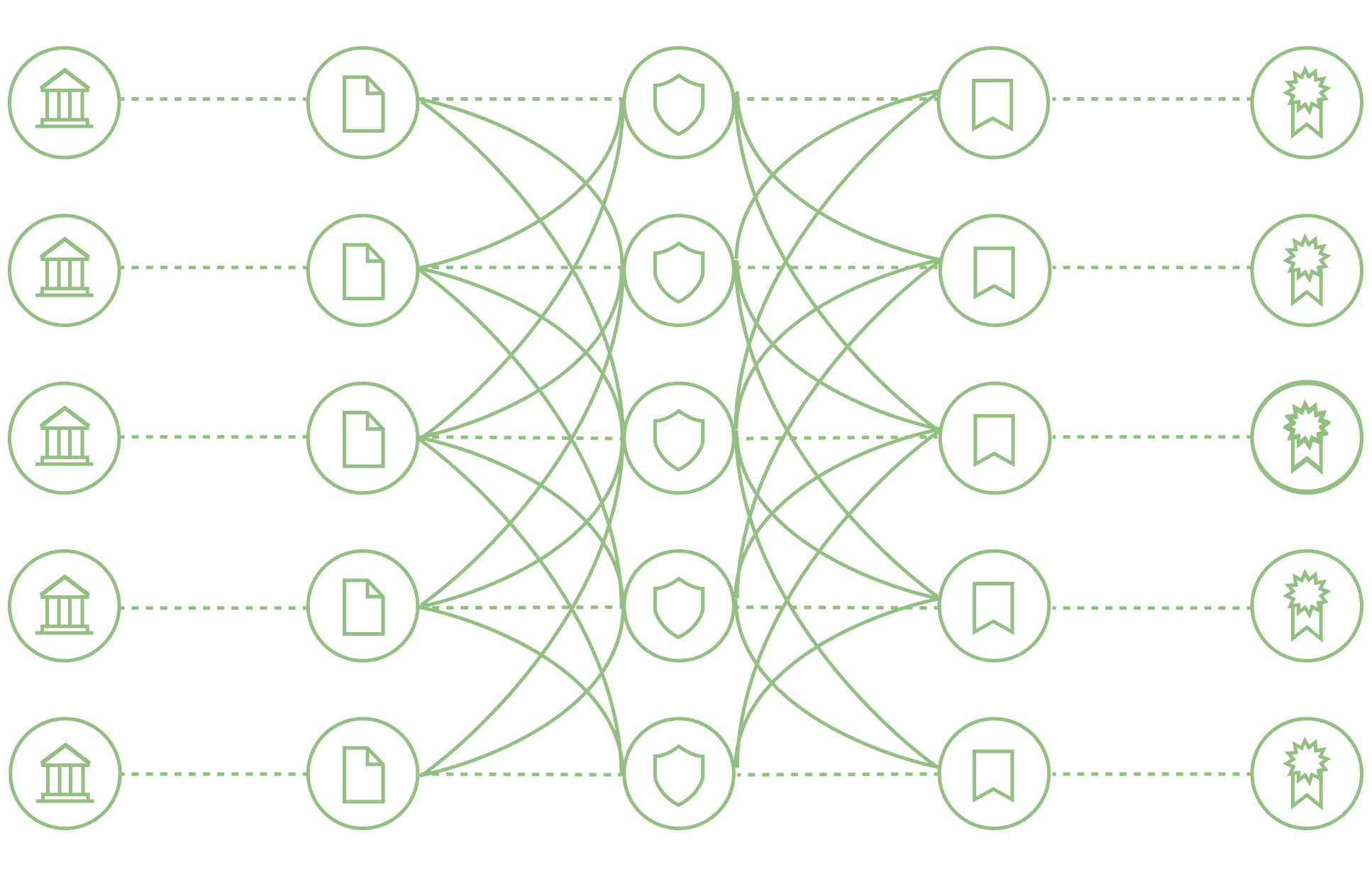
One right, three laws, one action to take.
Everything below is real data from the crosswalk, rendered live on this page, not a screenshot and not an example we wrote for the occasion. It follows the single most universal right in privacy law: delete my data. California calls it the right to delete, the EU calls it erasure, Virginia words it as the right to delete personal data. The crosswalk resolves all three to one shared SOC 2 criterion, which resolves to the exact policy paragraph telling your team how to answer the request.
California, USA
Read the full text
California state technology statutes — the California Consumer Privacy Act, the first and most prescriptive of the US state consumer-privacy laws, plus real enacted coverage in breach notification (the nation's first, and the template nearly every other state statute was modeled on), the original SOPIPA (Student Online Personal Information Protection Act) student-data statute, the Genetic Information Privacy Act (GIPA), the all-party-consent California Invasion of Privacy Act (CIPA) with an active website-tracking-litigation profile, the original state IoT-security law (SB-327), the Delete Act's centralized data-broker deletion platform, DROP (the Delete Request and Opt-out Platform), three enacted AI statutes spanning frontier-model safety disclosure through bot disclosure, a right-to-repair statute, and one of the oldest state medical-records confidentiality statutes in the country, the Confidentiality of Medical Information Act (CMIA), predating HIPAA (the Health Insurance Portability and Accountability Act) by over a decade.
European Union
Read the full text
The European Union as a supranational jurisdiction — home to the General Data Protection Regulation, the most influential and most-copied data protection statute in the world, binding across all EU (European Union)/EEA (European Economic Area) member states and extending extraterritorially to any organization that offers goods or services to, or monitors the behavior of, individuals in the Union. It also carries the Union's cybersecurity, digital-resilience, data-sharing, and AI rules: the NIS2 Directive, the Digital Operational Resilience Act, the Cyber Resilience Act, the Data Act, and the AI Act.
Virginia, USA
Read the full text
Virginia state technology statutes. Virginia's flagship statute is the Virginia Consumer Data Protection Act (VCDPA), the original "Virginia model" comprehensive privacy law that Colorado, Connecticut, Texas, and most subsequent state statutes were patterned after. Virginia also has real, enacted coverage in breach notification (a harm-triggered statute unusually paired with a narrow direct-economic-damages private remedy), a layered pair of SOPIPA (Student Online Personal Information Protection Act)-style/data-security student-data statutes, a direct-to-consumer genetic-privacy statute requiring itemized per-use consent, a one-party-consent wiretapping statute distinctively paired with a civil cause of action and liquidated damages, a 2020 adoption of the NAIC (National Association of Insurance Commissioners) Insurance Data Security Model Law with an annual compliance-certification duty, a HIPAA (Health Insurance Portability and Accountability Act)-adjacent health-records-privacy and medical-breach-notification pairing, and two narrow but real AI-generated-content criminal statutes (deepfake nonconsensual imagery, computer-generated CSAM) — notwithstanding the Governor's March 2025 veto of Virginia's would-be comprehensive AI statute.
California Consumer Privacy Act (CCPA)
Read the full text
California privacy statute establishing consumer rights to know, delete, correct, opt out of sale or sharing, limit the use of sensitive personal information, and receive notice at collection, together with CPPA (California Privacy Protection Agency) governance, rulemaking, and enforcement provisions.
General Data Protection Regulation (EU) 2016/679
Read the full text
The European Union's comprehensive data protection regulation, directly applicable across all EU (European Union)/EEA (European Economic Area) member states since May 25, 2018. It establishes the core principles governing any processing of personal data, enumerates the data subject rights (access, rectification, erasure, portability, and more) that give individuals control over their own information, sets out the distinct obligations of controllers and processors, and backs all of it with breach-notification duties and administrative fines that can reach 4% of global annual turnover. Its extraterritorial reach — Article 3 — means it applies to any organization, anywhere, that offers goods or services to individuals in the EU or monitors their behavior, which is why it is treated as the de facto global baseline for privacy programs.
Virginia Consumer Data Protection Act (VCDPA)
Read the full text
Virginia privacy statute establishing consumer rights to access, correct, delete, and port personal data, and to opt out of targeted advertising, sale, and certain profiling, together with controller obligations for purpose limitation, data minimization, and data protection assessments, enforced exclusively by the Virginia Attorney General with no private right of action.
1798.105 - Right to Delete
Read the full text
Consumers have the right to request deletion of personal information collected from them.
Article 17 - Right to Erasure ('Right to be Forgotten')
Read the full text
Article 17 is the most recognized provision of the GDPR (General Data Protection Regulation) outside privacy-professional circles — the "right to be forgotten." It gives individuals the right to have their personal data erased without undue delay when one of several grounds applies: the data is no longer necessary for the purpose it was collected for, consent has been withdrawn and there's no other lawful basis, the individual objects and there's no overriding legitimate ground, the data was processed unlawfully, or erasure is required to comply with a legal obligation. The right is not absolute — Article 17(3) preserves processing where necessary for freedom of expression, legal compliance, public interest archiving, or the establishment/defense of legal claims — but where it applies, "without undue delay" sets a real operational clock, generally understood within the same one-month window as other data subject rights under Article 12. Critically, if the data has been made public, the controller must also take reasonable steps, including technical measures, to inform other controllers processing that data that the erasure has been requested. Ultimately, Article 17 is why "right to delete" has become the shorthand the public uses for data privacy generally — it is the right most closely tied to the felt sense of control over one's own digital footprint, and the one whose mishandling generates the most reputational damage when a company claims to have deleted data and later turns out not to have.
59.1-577 - Right to Access, Correct, Delete, and Port Data
Read the full text
Section 59.1-577 bundles together the core set of consumer rights that most people think of when they picture "modern privacy law": the right to confirm whether a controller is processing your personal data and to access that data, the right to correct inaccuracies, the right to delete personal data you provided or that a controller obtained about you, and the right to obtain a portable copy of your data in a readily usable format so you can take it elsewhere. Together these four rights form the operational backbone of the statute. What distinguishes Virginia's approach is its restraint relative to California's original CCPA (California Consumer Privacy Act) text. There is no separate "right to know specific pieces of information collected over the past twelve months" style of granular disclosure obligation layered on top; the rights are more consolidated and, in practice, somewhat less operationally granular for the controller to fulfill, though no less real for the consumer exercising them. Ultimately, this section operationalizes the basic premise that data belongs, in a meaningful sense, to the person it describes. A controller is a steward, not an owner, and these four rights are the mechanism by which that stewardship is kept honest and answerable to the individual on the other end of the record.
P4 - Use, Retention, and Disposal
Read the full text
The entity limits the use of personal information to the purposes identified in the notice and for which the data subject has provided implicit or explicit consent, retains personal information for only as long as necessary to fulfill the stated purposes or as required by law or regulation, and disposes of, destroys, or de-identifies personal information when no longer needed.
American Institute of CPAs (AICPA)
Read the full text
AICPA (American Institute of Certified Public Accountants), publisher of the SOC (Service Organization Control) family of attestation frameworks — including the SOC 2 Trust Services Criteria — that independent CPA (Certified Public Accountant) firms use to examine and report on a service organization's controls over security, availability, processing integrity, confidentiality, privacy, cybersecurity risk management, and supply chain risk management.
SOC 2 - AICPA Trust Services Criteria
Read the full text
A voluntary attestation framework administered by the American Institute of Certified Public Accountants (AICPA) under which an independent CPA (Certified Public Accountant) firm examines and reports on the suitability of design and operating effectiveness of an entity's controls relevant to one or more Trust Services Categories: Security (the mandatory Common Criteria present in every report), Availability, Processing Integrity, Confidentiality, and Privacy. Unlike a prescriptive regulatory checklist, SOC (Service Organization Control) 2 is criteria-based — the entity designs its own controls to meet the Trust Services Criteria and the resulting Type I (point-in-time) or Type II (operating effectiveness over a review period) report is typically shared under an NDA (Non-Disclosure Agreement) with customers and prospects as evidence of a mature control environment.
Data Retention & Secure Disposal Policy
Read the full text
Defines how long specific categories of data (customer data, Controlled Unclassified Information (CUI), financial records, logs) must be retained to meet legal/contractual obligations, and the secure disposal methods required once that period expires. Distinct from the Document Control & Retention Policy in that it governs raw data and datasets rather than controlled documents; satisfies National Institute of Standards and Technology (NIST) SP 800-171 3.8.3 and International Organization for Standardization (ISO) 27001 Annex A 8.10.
Fulfilling Deletion & Erasure Requests
Read the full text
The operational procedure for handling a verified consumer deletion/erasure request end to end: identity verification, timeline, propagation across systems and processors, and the secure-disposal method used, satisfying California Consumer Privacy Act (CCPA) §1798.105 and General Data Protection Regulation (GDPR) Article 17.
Organizations usually choose among three options today, and each has a cost.
Every organization that suddenly owes someone a real, evidenced answer ends up choosing between the same three options, and all three ask you to give something up.
The spreadsheet
Free and fully under your control, but nothing in it can be verified. It works until someone asks how you know it is current.
The consultant
Real expertise, applied by hand. The engagement takes time and costs money, and when it ends, the understanding of your program leaves with the consultant.
The platform with your keys
It works by asking for API keys, service accounts, and standing access into exactly the systems a security program exists to protect.
The fourth option: the work runs in your tenant, under your sign-in.
The usual promise is "we won't look." Ours is that we can't.
This is not a policy we wrote down and hope to keep. It is the shape of the application, and it is enforced by its checks.
Your evidence never reaches us
Every answer, upload, and attestation is created and stored client-side, in storage provisioned inside your organization's own Microsoft 365 tenant. The application has no server that receives them, so we hold no copy. We receive only what you choose to send: a message through this site's contact form, or a bug report or feature request from the app.
There is no credential of yours to steal
The app authenticates with your signed-in user's own delegated Microsoft Entra ID token. We hold no service credential on your behalf, so no credential of yours exists on our side to be leaked, subpoenaed, or misused later.
Enforced by the code's checks, not by policy
The application's lint fails its checks on Server Actions and on API routes that read a request body or accept POST, PUT, PATCH or DELETE, apart from a short reviewed allow-list. A change that adds a server to receive your data cannot merge without first failing those checks.
Walk away and keep everything
Your attestations live in your tenant, in your Microsoft 365 subscription. If you stop using the app tomorrow, you keep every one of them. We never had the ability to hold them hostage.
See every Microsoft Graph permission the app asks for, and why
Map the obligations, examine each one, keep the proof.
Three questions every compliance program has to answer: what binds us, what have we done about it, and can we show our work later.
Map what binds you
Choose the standards and jurisdictions you fall under. The crosswalk resolves them into the actual set of mandates you owe, deduplicated across every framework that happens to share one, so a requirement you already meet stops showing up as four separate jobs.
Run the exam
Structured exams walk your team through each mandate: what it asks for, who is accountable, and what counts as an answer. The NIST CSF 2.0 function assessments are active today. Exams for CMMC Level 2, DFARS CUI protection, the HIPAA Security Rule, SOX 404, FISMA, and ISO/IEC 27001 are in draft.
Keep the attestation
Each answer becomes a timestamped, attributable attestation, written to storage provisioned inside your own Microsoft 365 tenant. Not marked complete. Evaluated, dated, and sourced.
Two kinds of teams arrive here, for opposite reasons.
One has been handed an obligation it never planned for. The other is choosing one, because a deal depends on it. Both need the same thing: a real answer, fast, without hiring a function they cannot afford.
A flow-down clause now applies to you
DFARS 252.204-7012 requires a prime contractor to put its safeguarding clause into subcontracts for operationally critical support, or whose performance involves covered defense information, whether or not the subcontractor has ever run a security program. Covered defense information is controlled unclassified information that is marked in the contract or handled in support of it.
A deal is blocked on a certification
An enterprise buyer, an insurer, or a partner now wants an attested answer before signing. You have no in-house compliance function and no interest in building one to close a single deal.
You answer the same question more than once
A federal rule, a state privacy statute, an insurer questionnaire, and a customer DPA all asking for the same control in four different vocabularies, and no way to prove to yourself that the four answers agree.
The questions a careful buyer asks first.
Do you need access to our systems?
We hold no API keys, no service accounts and no access of our own into your environment, and there is no agent to install. You sign in with your own Microsoft identity, and the application runs in your browser. It reads and writes your tenant under your own permissions.
Where does our evidence actually live?
In storage provisioned inside your organization's own Microsoft 365 tenant, the same place the rest of your organization's documents already live. We never receive a copy.
What happens when a law changes?
When we change the governance library, we publish it as a new version. It reaches your organization only when your tenant admin installs that version, and the admin can roll back.
Where does the governance library live, and can it change before an audit?
In your own SharePoint site. Your tenant admin installs it through the Portal as one pinned file, and the Portal refuses a file that does not match its declared hash. It changes only when that admin installs a newer version, and a deploy on our side never changes it. Each exam submission and each generated document records the version and hash of the library it was made against. The application reads the library from your SharePoint site, so our servers are not asked for any governance content when someone views it. What we can see is your admin's one-time download of the library file when they install a version, and that a browser loaded the application.
Which Microsoft clouds does it work in?
The Microsoft commercial cloud only. It is not available for Government Community Cloud High (GCC High) or DoD tenants, and the application cannot be pointed at either one by a setting. If your organization works in one of those clouds, this does not run there today.
What does it not do?
It does not certify your organization or replace an assessor, and it is not legal advice. It does not monitor your systems, scan your configuration, or read your tenant's security settings. It maps requirements across frameworks and records your answers as dated attestations in your own tenant.
What does it cost?
Pricing is not set, and this page quotes no number. We have ruled out per-seat pricing, because charging per person in a compliance tool teaches an organization to involve fewer people, and per-framework pricing, because shared requirements are the point of a crosswalk. We plan flat pricing per organization, scaled roughly to size.
Is it ready?
It is in closed alpha. The content library keeps growing because the law keeps changing, so it is never finished. What exists today is what this page renders from the live crosswalk, not a mockup.
See which obligations apply to your organization.
A Microsoft 365 administrator approves the app once for your organization, or sets it up in the Turbo Client Systems Portal. After that, sign in with your Microsoft work account to open the crosswalk against your own organization. The application sends us nothing you enter into it, except a bug report or feature request you choose to send.